
Tuesday, 14 July 2026
Steel beams are one of the strongest parts of any building. They support heavy loads, provide structural stability, and are commonly found in warehouses, factories, commercial buildings, and even modern homes. But what happens when you need to attach pipes, electrical conduits, lighting fixtures, cable trays, or other equipment to a steel beam?
Many people immediately think of welding or drilling holes into the beam. While those methods can work, they aren’t always the best choice. In fact, there are several ways to securely attach items to a steel beam without permanently changing its structure. These methods are faster, safer, and often more cost-effective for construction projects.
Here’s why more contractors are choosing no-weld, no-drill solutions.
Why Avoid Welding or Drilling?
Welding and drilling may seem like the obvious options, but they come with several downsides.
Drilling holes into a structural beam can weaken the steel if not carefully engineered. Welding, meanwhile, requires skilled workers, special permits in some cases, and can create heat that affects the beam’s protective coating or finish.
Both methods also take time. If changes are needed later, removing welded or drilled components can become expensive and labor-intensive.
That’s why many builders prefer non-invasive attachment methods whenever possible.
Beam Clamps: The Most Popular Solution
One of the easiest ways to attach equipment to a steel beam is by using beam clamps.
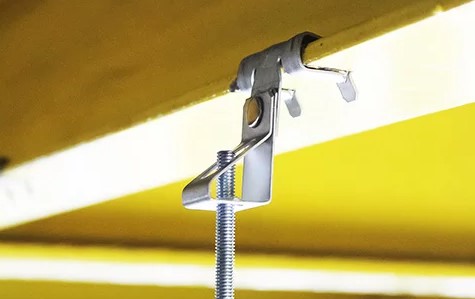
Beam clamps grip onto the flange of the beam without damaging the steel itself. Once installed, they provide a strong mounting point for threaded rods, brackets, cable supports, piping systems, or mechanical equipment.
Since they don’t require welding or drilling, installation is much quicker and cleaner. If adjustments are needed later, the clamp can simply be removed or repositioned.
This flexibility makes beam clamps especially useful for commercial buildings where layouts may change over time.
C-Clamps and Structural Clamps
Another popular option is structural C-clamps. These clamps work by tightening around the beam using bolts, creating a secure connection without altering the structure. They’re commonly used for temporary installations, maintenance work, and mechanical or electrical systems. Because they’re reusable, contractors often keep them on hand for multiple projects.
Hanging Systems for MEP Installations
Modern buildings contain complex mechanical, electrical, and plumbing (MEP) systems. Instead of drilling directly into steel beams, installers often suspend pipes, ducts, and cable trays using threaded rods connected to beam clamps.
This method allows equipment to be installed neatly while maintaining the integrity of the building’s structural steel.
It’s also easier to expand or modify these systems in the future.
Safety Comes First
Even though these attachment methods don’t require welding or drilling, choosing the correct hardware is still critical.
Every clamp has a specific load capacity, beam size compatibility, and intended application. Using the wrong clamp or exceeding its weight limit can create serious safety risks.
That’s why contractors should always follow the manufacturer’s specifications and ensure the selected attachment system matches the project’s structural requirements.
Better for Future Maintenance
One major advantage of no-weld solutions is easy maintenance.
If equipment needs replacing, upgrading, or relocating, installers can simply loosen the clamps and reposition everything without damaging the building.
This saves both time and money throughout the building’s life cycle.
A Smarter Way to Build
Modern construction is moving toward solutions that are efficient, flexible, and safe. Attaching equipment to steel beams without welding or drilling fits perfectly with this approach. It protects the structural integrity of the beam, reduces installation time, and makes future modifications much easier.
Whether you’re working on a factory, office building, warehouse, or commercial facility, non-invasive attachment systems offer a practical alternative to traditional methods. Choosing the right installation technique from the start can improve safety, reduce labor costs, and create a more adaptable building for years to come.